
The Pennsylvania Railroad GG1
The GG1 was designed by the Pennsylvania Railroad based on the need for a locomotive that could pull more than 12 to 14 passenger cars. The railroad thought it had designed the perfect electric passenger locomotive, the P-5a, but as the P-5a locomotives arrived, it became necessary to double head them on many trains in order to protect schedules. Two other factors were involved in the development of the GG1. The chassis and wheel arrangement were a result of experiments with a leased New Haven EP3a and the streamlined body and center crew cab were an outcome of concern for crew safety. A tragic grade crossing accident in which a box cab P-5a hit a truck killing the engineer, reinforced the need for better protection for the crew. After the accident, a hold was put on further manufacture of the box cab P-5a and the locomotive was redesigned to include a center crew cab. The GG1 was given a sculptured carbody with contoured hoods that were tapered to provide visibility for the enginemen. As a result, a very aesthetically pleasing design evolved. Raymond Loewy, the renowned industrial designer, reviewed the prototype and recommended welding the shell rather than using rivets. He then suggested adding the famous pin stripes, making the design an award winner.
The railroad built 139 units (#4800 through #4938) between the years 1934 and 1943. Many of them were built at the Juniata Locomotive Shop in Altoona, PA.
This streamlined locomotive, designed for bidirectional operation was mainly used for passenger trains, but a few were regeared for freight service. Lasting from 1934 to well into the 1980s it would be hard to find any other American locomotive design that operated for a longer period of time. The 79.5 foot long 230+ ton GG1 was built on an articulated frame which permitted its 2-C+C-2 wheel arrangement to negotiate tight curves even in congested areas. Power was picked up from an overhead 11,000 Volt AC catenary wire by a pantograph and the voltage stepped-down through an on board transformer to feed the 12 single phase 25 cycle traction motors. Each of these motors developed 385 HP giving the GG1 a total of 4620 HP in continuous operation and allowed speeds up to 100 mph. The body of the locomotive also housed large blowers for motor and transformer cooling, a steam boiler for passenger car heat, electric controllers and sanding boxes.

Of the 139 units built, only 16 survive today. Some have been restored superficially and can be visited as shown below. It is not likely that any of these survivors will ever run again because of the prohibitive cost to rebuild or replace the electrical components.
Surviving GG1s
| Locomotive No. | Location | Current Paint |
|---|---|---|
| PRR 4800 | Railroad Museum of Pennsylvania | Brunswick Green, 5 stripe |
Historical Notes
| ||
Outlook: C+ (Some deterioration)For a couple years, 4800 was out in the weather and was showing signs of deterioration. In 2002 it was moved into the expanded car barn. In 2004 it received a new paint job and underwent some cosmetic restoration. All lettering has been painted over sometime in the mid-2000's. In 2009 it was moved outside again. | ||
Photos
| ||


| Locomotive No. | Location | Current Paint |
|---|---|---|
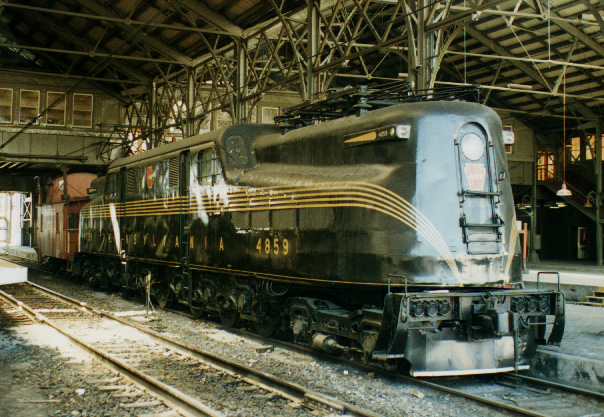
| PRR 4859 | Transportation Center, Harrisburg, PA | Brunswick Green, 5 stripe |
Historical Notes
| ||
Outlook: A (Good outlook for preservation)4859 belongs to the RR Museum of PA and is currently outside, under roof at the Harrisburg, PA Amtrak Station. Amtrak wants it out of their station soon. There is talk about a temporary display at Union Station in Washington, DC. One day 4859 will have to return to the museum in Strasburg, PA and when it does, there will be limited space and one of the three GG1s may have to go. | ||
Photos
| ||


| Locomotive No. | Location | Current Paint |
|---|---|---|
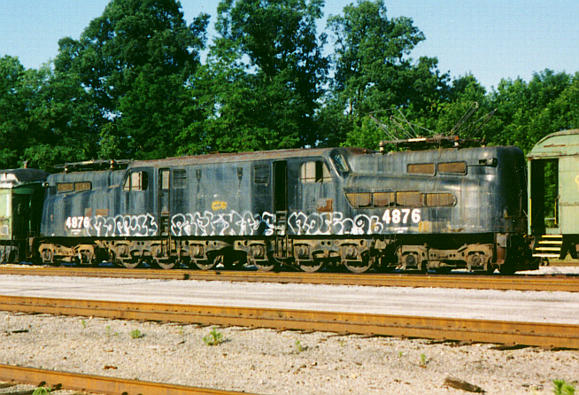
| PRR 4876 | B&O Museum, Baltimore, MD | Brunswick Green |
Historical Notes | ||
Outlook: C (Some deterioration)It is unfortunate that a GG1, with as much unique history as this one, was stored for so many years (1985 - 2007) in a nearby yard without protection from either vandals or the weather. In 2007 it was moved into the restoration shop compound area with some of the other large locomotives. | ||
Photos
| ||

| Locomotive No. | Location | Current Paint |
|---|---|---|
| PRR 4877 | URHS of NJ, siding in Boonton, NJ | Brunswick Green, 5 Stripe |
Historical Notes | ||
Outlook: B (Good outlook for preservation)
| ||
Photos
| ||


| Locomotive No. | Location | Current Paint |
|---|---|---|
| PRR 4879 | URHS of NJ, siding in Boonton, NJ | Brunswick Green bold single-stripe |
Historical Notes
| ||
Outlook: B- (Good outlook for preservation)4879 may have been located in Morristown around 2002. There were once plans to restore it to the Brunswick Green single stripe/large keystone scheme and display it a NJ Transportation Heritage Center in Phillipsburg, NJ. As of September 2008, 4879 was stored on a siding in Boonton, NJ with a selection of other obsolete equipment. In 2012 it was cosmetically restored to Brunswick Green with a single bold stripe. It is currently parked on the URHS siding and not easily seen. While protected from vandals, it sits outside subjected to the weather. | ||
Photos
| ||


| Locomotive No. | Location | Current Paint |
|---|---|---|
| PRR 4882 | National NYC Railroad Museum, Elkhart, IN | Penn Central Black with PC Logo |
Historical Notes
| ||
Outlook: C+ (Fair outlook for preservation)In October, 1998, 4882 was painted into its PC livery. The paint job is temporary. Longer range plans are to paint it in its original PRR livery. It currently sits outside unprotected from the weather. | ||
Photos | ||

| Locomotive No. | Location | Current Paint |
|---|---|---|
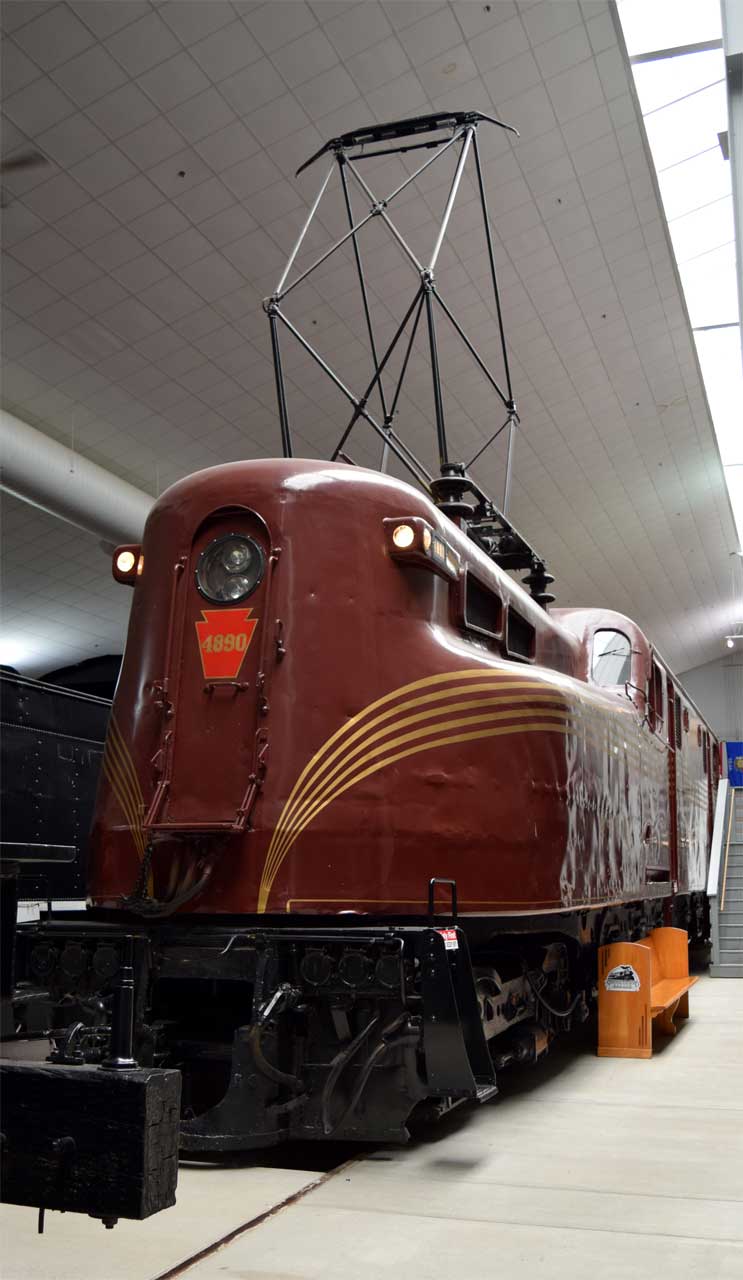
| PRR 4890 | National Railroad Museum, Green Bay, WI | Tuscan Red, Yellow Stripe |
Historical Notes
| ||
Outlook: A (Good outlook for preservation)4890 received a new paint job in 2000. It is now part of the new indoor display hall: Lenfestey Center, a 26,000 square foot climate controlled facility. It is displayed next to UP Big Boy 4017 and the General Eisenhower WWII Command Train. | ||
Photos
| ||


| Locomotive No. | Location | Current Paint |
|---|---|---|
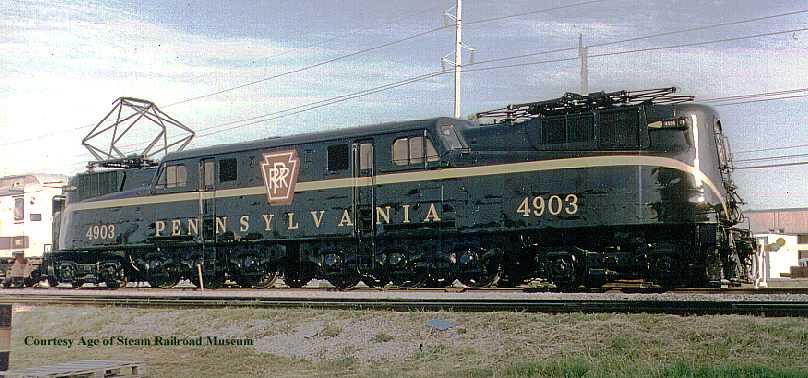
| PRR 4903 Amtrak 4906 |
Museum of the American Railroad, Frisco, TX | Brunswick Green, yellow stripe |
Historical Notes
| ||
Outlook: B+ (Good outlook for preservation)While protected from vandals, 4903 sits outside unprotected from the weather. | ||
Photos | ||
| Locomotive No. | Location | Current Paint |
|---|---|---|
| PRR 4909 Amtrak 4932 |
Cooperstown Junction Wye, Milford, NY | Amtrak Black |
Historical Notes
| ||
Outlook: D (Rapidly deteriorating)4909 is one of the two GG1s stored on the Cooperstown Junction Wye in Milford, NY. They are owned by the Leatherstocking Railway Museum. They appeared to be deteriorating with each photo that I see. As one of the photos show, 4932 was once located at the Steamtown National Historic Site. In July, 2001, I receive email from Joe Szarmach stating that he bought 4909 and was going to cosmetically restore it. I never heard any more information about this. In July, 2003 I heard that 4909 had been acquired by the Henry Ford Museum. In August 2004, I had heard that 4909 was finally moved to the Henry Form Museum. However, I later found that it was still at Cooperstown Junction, NY. I don't know what it is about 4909 that generates so much false information. The acquisition by the Henry Ford Museum appears to be valid however. There was a news article about it here and the information has been confirmed by the museum itself. I don't know how long that article will be available. Now that the Henry ford Museum has confirmed ownership of 4909, perhaps the rumors about this locomotive will now stop. Around 2018 they were moved from the siding and onto one leg of the wye. | ||
Photos
| ||


| Locomotive No. | Location | Current Paint |
|---|---|---|
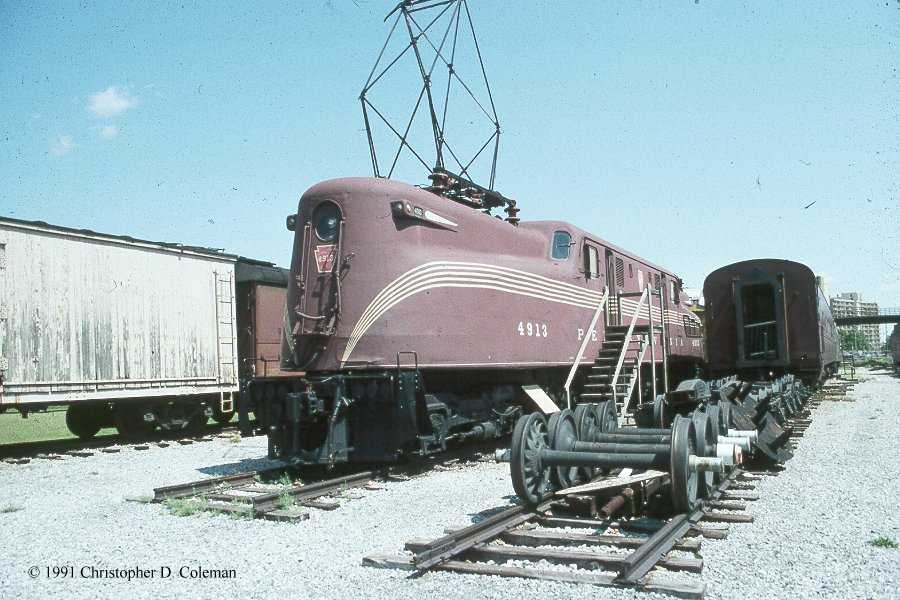
| PRR 4913 Amtrak 4913 |
Railroader's Memorial Museum, Altoona, PA | Tuscan Red, 5 Stripe |
Historical Notes
| ||
Outlook: C (Slowly deteriorating)While protected from vandals, 4913 sits outside unprotected from the weather. | ||
Photos | ||


| Locomotive No. | Location | Current Paint |
|---|---|---|
| PRR 4917 Amtrak 4934 |
Cooperstown Junction Wye, Milford, NY | Amtrak Black |
Historical Notes
| ||
Outlook: D (Rapidly deteriorating)4917 appears to be deteriorating more with each photo that is sent to me. In October of 2007 I was informed that 4917 was being acquired by the GG1 Historic Locomotive Preservation Society of Miami, FL. In the spring of 2008 it was to be moved to its new home in Miami and begin to receive cosmetic restoration work as part of a new TV show. Contact Raymond Meyers for more details. Today, this locomotive still sits on the Cooperstown Junction Wye. | ||
Photos
| ||


| Locomotive No. | Location | Current Paint |
|---|---|---|
| PRR 4918 Amtrak 4916 |
Museum of Transportation, St. Louis, MO | Amtrak Black |
Historical Notes
| ||
Outlook: C+ (Slowly deteriorating)4918 is under roof and protected from the weather. It is currently buried between other equipment and cannot easily be seen. | ||
Photos | ||

| Locomotive No. | Location | Current Paint |
|---|---|---|
| PRR 4919 Amtrak 4917 |
VA Museum of Transportation, Roanoke, VA | Amtrak black |
Historical Notes
| ||
Outlook: B (Fair outlook for preservation)4919 was painted Amtrak black in 2015. Prior to that it was painted Brunswick green, 5-stripe. 4919 is under roof a semi-protected from the weather. | ||
Photos
| ||


| Locomotive No. | Location | Current Paint |
|---|---|---|
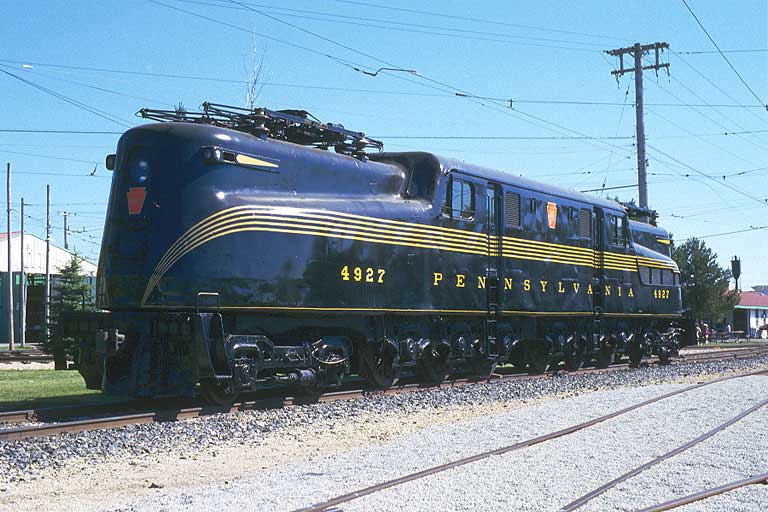
| PRR 4927 Amtrak 4939 |
Illinois Railway Museum, Union, IL | Brunswick Green, 5 stripe |
Historical Notes
| ||
Outlook: A (Good outlook for preservation)4927 is stored indoors in Barn No. 9. In August of 1999 it received a new Brunswick Green/5 stripe paint job. | ||
Photos | ||

| Locomotive No. | Location | Current Paint |
|---|---|---|
| PRR 4933 Amtrak 4926 |
Central NY Chapter NRHS, fairgrounds, Syracuse, NY | Amtrak Platinum Mist |
Historical Notes
| ||
Outlook: B- (Fair outlook for preservation)In 2009 this locomotive was repainted into the Amtrak Platinum Mist (red, blue and silver) paint shceme. It is on display outside, unprotected from the weather. | ||
Photos
| ||


| Locomotive No. | Location | Current Paint |
|---|---|---|
| PRR 4935 Amtrak 4935 |
Railroad Museum of Pennsylvania | Brunswick Green, 5 stripe |
Historical Notes
| ||
Outlook: A+ (Excellent outlook for preservation)4935 is in the best shape of all the surviving GG1s . It is indoors in a climate controlled building. In 2009 it was reported that it was in the repair shop. | ||
Photos
| ||


The Last Scrapped GG1s
| Locomotive No. | Last Location | Last Paint | Date Scrapped | Photos |
|---|---|---|---|---|
| PRR 4872 | New Jersey Transit | black | unknown | NJT 4872 |
| PRR 4873 | Private Owner, Whippany Railroad Museum, Whippany, NJ | black, white Penn Central logo | sold for scrap, 1992 | NJT 4873 |
| NJT 4883 | Naporano | 1980s | NJT 4883 (drawing by Tom Dowling) |


GG1 Numbering Explained
| PRR | Amtrak | PRR | Amtrak | PRR | Amtrak | PRR | Amtrak |
|---|---|---|---|---|---|---|---|
| 4892 | 900 -> 4900 | 4907 | 908 -> 4908 | 4917 | 4934 | 4927 | 4939 |
| 4897 | 901 -> 4901 | 4908 | 909 -> 4909 | 4918 | 916 -> 4916 | 4928 | 922 -> 4922 |
| 4899 | 902 -> 4902 | 4909 | 4932 | 4919 | 917 -> 4917 | 4929 | 923 -> 4923 |
| 4900 | 903 -> 4903 | 4910 | 910 -> 4910 | 4920 | 918 -> 4918 | 4931 | 924 -> 4924 |
| 4901 | 904 -> 4904 | 4911 | 911 -> 4911 | 4921 | 4936 | 4932 | 925 -> 4925 |
| 4902 | 905 -> 4905 | 4912 | 912 -> 4912 | 4922 | 4937 | 4933 | 926 -> 4926 |
| 4903 | 906 -> 4906 | 4913 | 913 -> 4913 | 4923 | 4938 | 4934 | 927 -> 4927 |
| 4904 | 4930 | 4914 | 914 -> 4914 | 4924 | 919 -> 4919 | 4935 | 4935 |
| 4905 | 4931 | 4915 | 4933 | 4925 | 920 -> 4920 | 4937 | 928 -> 4928 |
| 4906 | 907 -> 4907 | 4916 | 915 -> 4915 | 4926 | 921 -> 4921 | 4938 | 929 -> 4929 |
GG1 Deliveries
| Qty. | Road Numbers | Year Built |
|---|---|---|
| 1 | 4800 | 1934 |
| 57 | 4801 - 4857 | 1935 |
| 5 | 4858 - 4862 | 1937 |
| 9 | 4863 - 4871 | 1938 |
| 17 | 4872 - 4888 | 1939 |
| 20 | 4889 - 4908 | 1940 |
| 2 | 4909 - 4910 | 1941 |
| 18 | 4911 - 4928 | 1942 |
| 10 | 4929 - 4938 | 1943 |
GG1 Paint Schemes
| 1935 | |
|---|---|
| All GG1s: |
|
| 1941 | |
| All GG1s: |
|
| 1952 | |
| Ten GG1s: |
|
| 1955 | |
| Three GG1s: |
|
| Two GG1s: |
|
| All GG1s: |
|


GG1 Specifications
| Wheel Arrangement | 2-C+C-2 (4-6-6-4) |
|---|---|
| Operation | Bidirectional |
| Length | 79'-6" |
| Width | 10'-6" |
| Height | 15'-0" (with pantograph locked down) |
| Drivers | 57" dia. |
| Truck Wheels | 36" dia. |
| Weight (Locomotive #4800) | Per Axle: 50,500 lbs Per End Truck: 86,000 lbs Total: 475,000 lbs |
| Weight (Locomotive #4801-4857) | Per Axle: 50,000 lbs Per End Truck: 80,000 lbs Total: 460,000 lbs |
| Weight (Locomotive #4858-4868 & 4889-4938) | Per Axle: 50,500 lbs Per End Truck: 87,000 lbs Total: 477,000 lbs |
| Weight (Locomotive #4869-4888) | Per Axle: 50,000 lbs Per End Truck: 84,200 lbs Total: 468,400 lbs |
| Line Voltage | 11,000 Volts, 25 Cycles (HZ) AC |
| Transformer | 4800 KVA (weighed 30,300 lbs) |
| Traction Motors | 12 @ 385 HP |
| Total HP | 4620 HP |
| Drawbar HP | 10,000 HP |
| Drive | geared quill through spring and cup |
| Control | Tap Changer |
| Traction Effort | 65,500 lbs with 24 : 77 gearing (100 mph) 72,800 lbs with 22 : 79 gearing (90 mph) |
| Acceleration | 0 to 100 mph in 65 seconds with 24 : 77 gearing |
| Boiler | 4500 lbs of steam per hour at 200 psi (weighed 14,200 lbs) |
| Boiler Water | 2,761 gallons (except #4800 had a boiler capacity of 2,245 gallons) |
| Boiler Oil | 424 gallons |
| Compressor | 150 cfm displacement at 100 rpm |
| Blowers | 2 @ 55 HP |
| Aux. Battery | 32 Volts, 300 amp/hours |
GG1 Glossary
- Brunswick Green
- Officially listed as PRR dark green locomotive shade and is sometimes defined as 8 parts black and 1 part green.
- Carbody
- Another name for the shell or skin of the GG1
- Catenary
- The supporting wires and structures to carry the overhead current conducting wire from which electric locomotives obtain power.
- Cat Whiskers
- The pin stripes on the GG1
- Double Pantograph Order
- On icy days or during sleet conditions both pantographs were ordered to be up. With both pantographs up the leading one would act as a scrapper to insure that the trailing one would make good contact with the overhead wire.
- Frame
- Foundation or chassis upon which a locomotive is built.
- Front
- The half of the GG1 that contained the steam boiler was designated the "front" or end #1 the other half was designated end #2. Most GG1's had an "F" on the carboby to indicate the front end. Messenger Wire - The graceful shaped wire that carries the trolley wire.
- Motor
- A descriptive term used on the PRR to mean electric locomotive.
- Multiple Unit
- Two or more locomotives coupled together under the control of one engineer. Controls on the individual locomotives are interconnected via electric cables (MU cables) or hoses so they act in concert with the single control.
- Overhead
- Catenary and contact wire of a suspended electrical distribution system.
- Pantograph
- A device mounted on the roof of an electric locomotive that is spring loaded to allow the pick-up shoe to maintain contact with the overhead trolley wire.
- Quill Drive
- Traction motors are mounted on a hollow tubes called a quills. The quills are concentric to the driving axles and connected to large gears which in turn are connected to the driving wheels. The gears are turned by pinions mounted on the motor shafts. The GG1 used two traction motors per axle with each motor having a shaft and pinion on each end.
- Sand Box
- A receptacle on a locomotive for storing sand that is pneumatically delivered through piping to the rails directly in front of the driving wheels. The sand provides increased grip for the wheels to prevent slipping.
- Steam Boiler
- Steam producing unit consisting of a fire box surrounded by a water space to produce steam for heating passenger cars.
- Toluidine Red
- Red color used on PRR keystones.
- Traction Motor
- The electric motor geared to the axles and used to convert the transformer output to mechanical force in the form of tractive effort.
- Tractive Effort
- The measurement of the force exerted by a locomotive at the point where the wheel tread meets the rail.
- Trolley Wire
- The current conducting wire that the shoe on the pantagraph rubs to transmit power to the locomotive.
- Tuscan Red
- The brownish red color of many PRR freight and passenger cars. The color that 10 GG1's were painted in the early 1950's.
- Wheel Arrangement
- The GG1 wheel arrangement would be indicated as 4-6-6-4 in steam locomotive terms. On the PRR, the 4-6-0 was designated as Class G. A GG1 is two 4-6-0's back-to-back, thus the "GG" and the one indicates the first design. Electric locomotives are classified by their motored and unmotored axels. The GG1 is indicated as a 2-C+C-2. The + sign indicates an articulated arrangement, the "C" means three powered axles and "2" means two unpowered axles.
Will a GG1 ever run again?
A GG1 will probably never run again. Steam locomotives can be restored through extraordinary efforts, if needed, to repair or remanufacture mechanical parts. Once a steam locomotive has been restored, all one needs is coal (or oil) and water, to have the ability to run if track is available.
The GG1 survivors have had their transformers removed, many of the traction motors have shorted out and all of the other current carrying parts have deteriorated to the point of uselessness. The one exception may be 4935 in Strasburg, PA which may be capable of actually running if a transformer and a proper catenary were available. The GG1 was a 25 cycle (HZ) machine for which the PRR maintained their own substation to provide the 25 cycle current.
Locomotives today are capable of operating on 25 HZ or 60 HZ and most railroads are using 60 HZ so they can buy power directly from the power companies and avoid the expense of maintaining their own substations.
There is also a possible problem with contamination from PCB's, which to this point no one talks about. The GG1 transformer was cooled with a fluid known generically as Askarel (a non-flammable synthetic liquid dielectric). This liquid contains PCB's, and any evidence of PCB's would be a show stopper.
Many of the GG1s had developed cracks in their frames which means major repair or replacement would be needed. In addition the drivers, the trucks, and the carbody would have to refurbished. After that, all new electrical components and controls would have to be furnished. This could possibly cost around $1.5 to $2.0 million.
I seriously doubt that anyone would spend the money to get a GG1 to run. Some have spent large sums to refurbish steam locomotive but only where there has been available track to allow excursion to provide payback.
With all new electrical equipment and modern controls, this new GG1 could run on the Northeast Corridor or any other electrified railroad but, it would not be an authentic GG1, it would simply be a modern electric locomotive with the carbody of a GG1. Unfortunately changes in technology have finally, after 60 years, forced the retirement of the most durable locomotive of all time.
GG1 Web Pages

GG1 References
- The Remarkable GG1 by Karl R. Zimmermann (Quadrant Press Review)
- Pennsy Electric Years" by William D. Volkmer (Morning Sun Books)
- Pennsy Power, Steam and Electric Locomotives of the Pennsylvania Railroad 1900-1957 by Alvin F. Staufer (The Standard Printing & Publishing Co.)
- Under Pennsy Wires by Paul Carleton (D. Carleton Railbooks)
- When the Steam Railroads Electrified by William D. Middleton (IKalmback Books)
- Electric Traction of the Pennsylvania Railroad 1895 - 1968 by Michael Bezilla (The Pennsylvania State University)
- Vintage Rails by Pentrex, Inc., Fall 1995